
Three in four shoppers (74%) switched brands in the past year. That's the number in Salesforce's 2026 retail and consumer goods loyalty guide, and 66% cited high prices as one reason they left. Loyalty, it turns out, works more like a rental than a deed. But the brands that keep it get paid for it. At Reformation, 70% of 2025 revenue came from repeat customers, and returning customers spent double what new ones did.
We pulled the latest brand loyalty statistics from Salesforce, Deloitte, BCG, Morning Consult, YouGov, Baymard Institute, Amp and Go Fish Digital, then added review data from INTO THE AM's own tees. The sections below cover how loyal shoppers really are, where men differ, what earns the second order, what a repeat customer is worth, and what loyalty programs actually do. Short version? In men's basics, the shirt does most of the work.
Key Takeaways
- 74% of shoppers switched brands in the past year, according to Salesforce's 2026 guide.
- Gen Z and Gen Alpha are 20 percentage points less likely than older generations to buy the same brand consistently (BCG, 2025).
- Apparel shoppers want fit first: 48% say size accuracy and fit details are what they most want from reviews (Baymard Institute, 2026).
- Repeat buyers carry the business. At Reformation they made up 70% of 2025 revenue.
Brand Loyalty Statistics 2026: 74% of Shoppers Switched Brands
Start with the cold water. Salesforce's 2026 guide puts the share of shoppers who switched brands in the past year at 74%, with 66% citing high prices as one reason they left. Apparel looks worse. Alliant, surveying a nationally representative group of U.S. adults (reported by Retail TouchPoints in October 2026), found that only 16% of shoppers say they are loyal to an apparel brand. Younger buyers drift the most. BCG's October 2025 survey of more than 9,000 U.S. consumers calls Gen Z and Gen Alpha "product-loyal, not brand-loyal," and Morning Consult's 2025 polling backs it up: 39% of Gen Zers usually make an effort to try new apparel brands, and 51% had cut back or stopped shopping with a particular one.
| Metric | Figure | Source |
|---|---|---|
| Shoppers who switched brands in the past year | 74% | Salesforce, 2026 |
| Shoppers who cited high prices as one reason they left | 66% | Salesforce, 2026 |
| Shoppers who say they are loyal to an apparel brand | 16% | Alliant, via Retail TouchPoints, 2026 |
| Gen Z and Gen Alpha vs. older generations, buying the same brand consistently | 20 percentage points less likely | BCG, 2025 |
| Gen Z who usually try new apparel brands | 39% | Morning Consult, 2025 |
| Gen Z who reduced or stopped shopping with an apparel brand | 51% | Morning Consult, 2025 |
| Brand loyalty rating, 1 to 10: Baby Boomers / Gen X / Millennials / Gen Z | 7.36 / 6.96 / 6.61 / 6.57 | Go Fish Digital, 2025 index |
Key Insights
- The generation gap is real but narrower than the headlines. On Go Fish Digital's 1-to-10 scale, Baby Boomers rate their loyalty at 7.36 and Gen Z at 6.57. Nobody is a lock.
- Go Fish also found that shoppers repurchase from the same brand more often for essentials like groceries and toiletries than for discretionary buys like clothing. A plain tee is clothing on paper and a staple in practice. That's the opening for a basics brand.
Men and Brand Loyalty: A Tiny Gap, Fewer Shopping Trips
Are men more brand loyal? Not really. Alliant found no meaningful difference between men and women in apparel loyalty, and Go Fish Digital's index has women at 6.87 against 6.76 for men. The gap that matters is how often he shops. YouGov's British data has 17% of men buying clothes at least once a month, versus 26% of women. That's the UK, but the pattern is hard to wave away. Fewer trips, fewer second chances. Labels don't carry the weight you'd guess, either: only 24% of U.S. consumers say the label matters when they buy clothes, according to YouGov Profiles data reported by Retail Brew in August 2026. Brand-conscious shoppers do lean male, though, with men making up 53% of that group.
| Metric | Figure | Source |
|---|---|---|
| Loyalty rating, women vs. men (1 to 10) | 6.87 vs. 6.76 | Go Fish Digital, 2025 index |
| U.S. gap in apparel brand loyalty between men and women | No meaningful difference | Alliant, via Retail TouchPoints, 2026 |
| Shop for clothes at least monthly, men vs. women (Britain) | 17% vs. 26% | YouGov, 2025 |
| In a retail rewards or loyalty program, men vs. women (Britain) | 80% vs. 90% | YouGov, 2026 |
| Only buy the best-known brands, men vs. women (Britain) | 19% vs. 13% | YouGov, 2026 |
| U.S. consumers who say the label is important when buying clothes | 24% | YouGov Profiles, via Retail Brew, 2026 |
| Men's share of "brand-conscious" U.S. shoppers | 53% | YouGov Profiles, via Retail Brew, 2026 |
Key Insights
- Men and women look alike on loyalty. What differs is the calendar. A guy who buys clothes less often gets fewer chances to come back, so the first order has to land.
- Only about one in four says the label matters. A tee with no logo on it has to earn the rebuy on feel and fit.
What Keeps Customers Coming Back: Price, Quality and Fit Before Perks

Deloitte's 2025 Consumer Loyalty Program Survey, fielded in September and October 2025 among 5,564 U.S. loyalty program members, found that price, value and quality remain the top drivers of brand loyalty across all age and income groups, with loyalty programs close behind. Value isn't only price, either. Deloitte says up to 40% of a brand's perceived value comes from factors other than price. On the way out the door, Go Fish Digital's survey of 3,244 U.S. consumers found a price increase would send 43.8% of them away, a higher-quality competitor product 23.7%, and a bad service experience 18.1%. Clothes add one more lever. Baymard Institute's 2026 study of 1,922 U.S. online shoppers found that size accuracy and fit details (48%) are the information shoppers want most from reviews, ahead of quality and durability over time (43%).
| Finding | Figure | Source |
|---|---|---|
| Share of a brand's perceived value driven by factors other than price | Up to 40% | Deloitte, 2025 survey |
| Consumers who would leave a favorite brand over a price increase | 43.8% | Go Fish Digital, 2025 index |
| Would leave over a higher-quality competitor product | 23.7% | Go Fish Digital, 2025 index |
| Would leave after a negative customer service experience | 18.1% | Go Fish Digital, 2025 index |
| Apparel shoppers who most want size accuracy and fit details from reviews | 48% | Baymard Institute, 2026 |
| Apparel shoppers who most want quality and durability over time | 43% | Baymard Institute, 2026 |
| Shoppers who stopped buying from a retailer because its return policy fell short | 47% | Rithum, 2025 (global survey) |
Key Insights
- Price is the loudest reason to leave. Fit may be the quietest reason to stay. Nobody writes a five-star review because a shoulder seam sat where it should, yet 48% of apparel shoppers go hunting for exactly that detail.
- Returns feed loyalty, too. Rithum's 2025 global survey found 47% had stopped shopping with a retailer over its return policy. We dug into how closely that ties to fit in The True Cost of Returns.
What a Repeat Customer Is Worth: 70% of Reformation's 2025 Revenue
Reformation sells women's clothes, but its numbers show what retention does for a direct-to-consumer apparel brand. In its first public earnings report, covered by Modern Retail in September 2026, the company said 70% of 2025 revenue came from repeat customers. Returning customers spent double what new ones did. The rest of DTC has a harder time with the first sale. Amp's 2025 DTC Mega Report, built on $10.1 billion in Shopify DTC sales across 77 million customers, found that 37% of brands don't recover customer acquisition cost on the first order, and it put the 90-day repurchase rate for new customers at 14.7%. Harvard Business Review's much-quoted line from 2014 still frames the math: acquiring a customer costs five to 25 times more than keeping one.
| Metric | Figure | Source |
|---|---|---|
| Reformation revenue from repeat customers (2025) | 70% | Modern Retail, reporting Reformation, 2025 data |
| Returning vs. new customer spend at Reformation (2025) | 2x | Modern Retail, reporting Reformation, 2025 data |
| Shopify DTC brands' 90-day repurchase rate for new customers | 14.7% | Amp (Lifetimely), 2025 |
| DTC brands that don't recover acquisition cost on the first order | 37% | Amp (Lifetimely), 2025 |
| Cost of acquiring a new customer vs. keeping one | 5 to 25 times | Harvard Business Review, 2014 |
Key Insights
- Put Amp's two numbers side by side. Only 14.7% of new customers buy again within 90 days, and 37% of brands never earn back what they spent to find the customer on order one. The second purchase is where the model works, or doesn't.
- Reformation isn't a tee brand, so read its 70% as a ceiling, not a forecast. It does show where the money sits once a brand stops renting its customers.
Loyalty Program Statistics: 72% Spend More, but Members Use Only 5 of 8
Programs do move behavior. Or members say they do. In Deloitte's 2025 survey of loyalty program members, 72% said programs make them more likely to spend with their preferred brand, and 56% said they increase their spending because of one. But the average consumer enrolls in eight programs and actively uses only five. Salesforce's 2026 guide shows the same slack: 77% of shoppers belong to at least one program, 35% belong to one they've never used, and 84% of members say programs make them more likely to repurchase.
| Metric | Figure | Source |
|---|---|---|
| Members who say programs make them more likely to spend with their preferred brand | 72% | Deloitte, 2025 survey |
| Members who increase their spending because of the program | 56% | Deloitte, 2025 survey |
| Programs the average consumer enrolls in vs. actively uses | 8 vs. 5 | Deloitte, 2025 survey |
| Shoppers who belong to at least one loyalty program | 77% | Salesforce, 2026 |
| Shoppers in a program they have never used | 35% | Salesforce, 2026 |
| Members who say programs make them more likely to repurchase | 84% | Salesforce, 2026 |
Key Insights
- Sign-ups aren't loyalty. More than a third of shoppers hold a membership they've never touched.
- These are self-reported numbers from people who already joined, so read "spends more" as a correlation. And for a low-ticket basic, points won't carry the relationship alone. The product has to.
INTO THE AM Basic Tee: What 7,751 Reviews Say

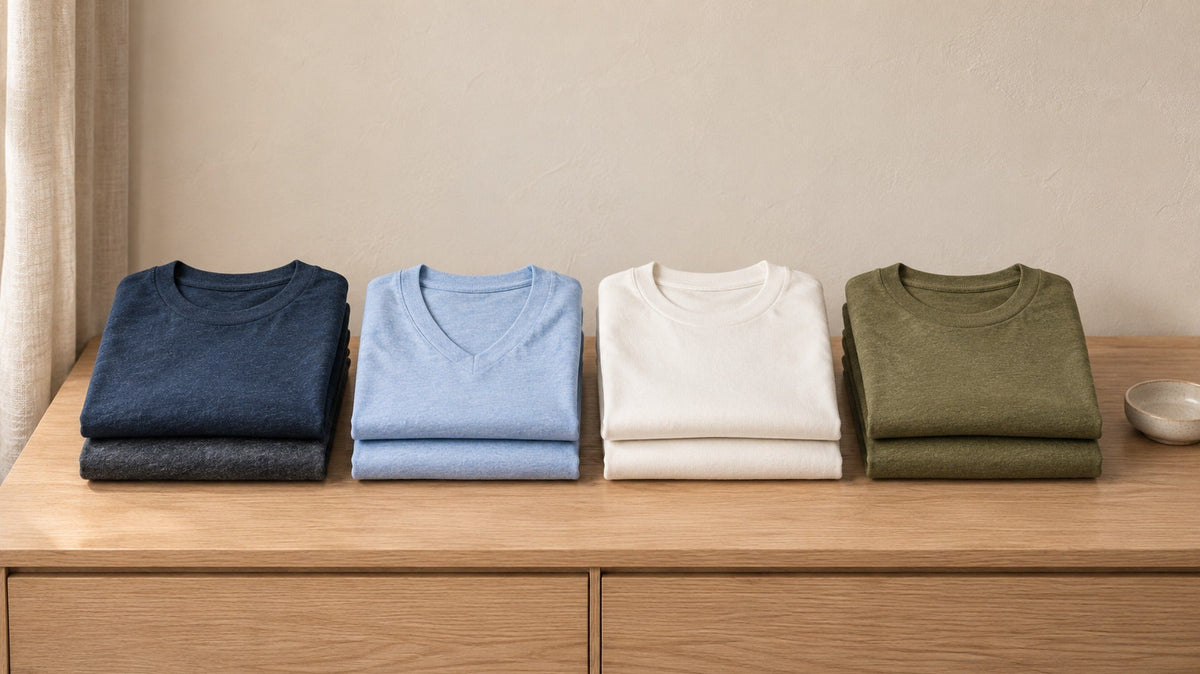
A tee brand earns the second order one shirt at a time. The Basic Tee anchors the range: it hugs the arms and chest, stays loose at the midsection, and comes in sizes S to 4XL with a Tall length that adds 2 inches of body and 1 inch of sleeve. Around it sit the V-Neck Tee, the thicker Heavyweight Tee and the Active Tee. Here's how shoppers on intotheam.com rated the Basic Tee and the V-Neck, as of November 2026. INTO THE AM also sells a membership for $12 a year, which its page says covers 10% off a first order, 20% cash back and free U.S. shipping.
| Metric | Figure |
|---|---|
| Basic Tee fit ratings collected | 3,136 |
| Basic Tee rated true to size | 86% |
| Basic Tee rated comfortable | 95% (3,096 ratings) |
| Basic Tee average star rating | 4.4 out of 5 (7,751 reviews) |
| V-Neck Tee rated true to size | 87% (236 fit ratings) |
| V-Neck Tee rated comfortable | 94% (234 ratings) |
| V-Neck Tee average star rating | 4.4 out of 5 (1,154 reviews) |
Key Insights
- Fit that stays put is what the loyalty research keeps pointing at. 86% of the Basic Tee's raters call it true to size, and the V-Neck lands in the same place at 87%. Different neckline, same story. The rest split almost evenly between "runs small" and "runs large," which reads more like personal taste than a cut that drifts.
- A practical move if you're reordering: write down your size and length once. Reg or Tall, same size, same shirt. And if a tee always rides up on you, Tall is the fix.
Further Reading
- The True Cost of Returns: Why Fit Matters in Men's Apparel
- How Men Shop for Basics: A Consumer Behavior Study
- The Rise of Direct-to-Consumer Menswear Brands
- Best Fitted T-Shirts for Men, 2026 Rankings
- Shop Men's Basic Tees
About INTO THE AM: INTO THE AM has sold men's apparel online since 2012, and the Basic Tee is still where most guys start: a soft cotton-blend tee cut to fit through the arms and chest without clinging at the middle, in sizes S to 4XL plus Tall. Find your size at intotheam.com.
Sources
- Salesforce: The New Loyalty Landscape (retail and consumer goods loyalty guide, 2026)
- BCG: Gen Z and Gen Alpha Set to Drive 40% of Fashion Spending by 2035
- Retail TouchPoints: Alliant, The Why Behind the Buy (October 2026)
- Morning Consult: Gen Z's Pursuit of Novelty Presents a Challenge for Brands (2025)
- Morning Consult: Retail Briefing, Back-to-School Budgets and Discount Shoppers (2025)
- Go Fish Digital: The 2025 Brand Loyalty Index
- YouGov: The Gender Divide, How British Men and Women Shop Differently (2026)
- YouGov: Shopping Trends, How Men and Women Shop for Clothes in Britain (2025)
- Retail Brew: Brand-Conscious Shoppers Are Twice as Likely to Spend More (YouGov Profiles, 2026)
- Deloitte Insights: Reshaping Loyalty Programs in an Era of Value Seeking
- Baymard Institute: Apparel and Accessories Quantitative UX Insights 2026
- Rithum: 2025 Global Returns and Profit Impact Report
- Modern Retail: Reformation Says Active Customers Grew 23% in First Public Earnings Report
- Amp (Lifetimely): The 2025 DTC Mega Report
- Harvard Business Review: The Value of Keeping the Right Customers (2014)
- INTO THE AM: Basic Tee fit ratings
- INTO THE AM: V-Neck Tee fit ratings
- INTO THE AM: Membership
 Your Privacy Choices